

Buying real estate in Dubai is one of the most attractive investment opportunities in the world, but the purchase price is only part of your total investment. Dubai Property Buying Costs include several mandatory government fees, registration charges, agency commissions, financing costs, and ongoing service charges that every buyer should understand before signing a sales agreement.
Whether you’re purchasing your first apartment, investing in an off-plan project, or buying a luxury villa, knowing the full cost of ownership helps you plan your budget accurately and avoid unexpected expenses. In this guide, you’ll learn exactly what you’ll pay in 2026, which costs are unavoidable, where you may be able to save money, and how different property types compare in terms of overall ownership costs.
Table of Contents
How much does it cost to buy property in Dubai in 2026?
In addition to the property’s purchase price, buyers in Dubai typically pay government transfer fees, registration charges, trustee office fees, agency commissions, mortgage-related fees (if financing), and annual service charges. For most residential purchases, total upfront buying costs are approximately 6% to 8% of the property’s value, while ongoing annual costs depend on the property’s size, location, and community management fees.
Dubai Property Buying Costs Explained
Many first-time buyers assume that paying the property’s advertised price completes the transaction. In reality, purchasing property in Dubai involves several additional costs that should be included in your investment calculation from the beginning.
These expenses generally fall into two categories:
| Upfront Costs | Ongoing Costs |
|---|---|
| Dubai Land Department (DLD) Transfer Fee | Annual Service Charges |
| Trustee Office Fee | Property Maintenance |
| Registration Fee | Home Insurance (optional) |
| Agency Commission | Property Management Fees |
| Mortgage Fees (if applicable) | Utility Connections |
Understanding both categories allows investors to calculate their true acquisition cost and estimate future rental returns more accurately.
Mandatory Government Fees
Government fees are unavoidable regardless of whether you’re buying a ready property or an off-plan unit.
The following table summarizes the primary government charges buyers should expect in 2026.
| Fee | Typical Cost |
|---|---|
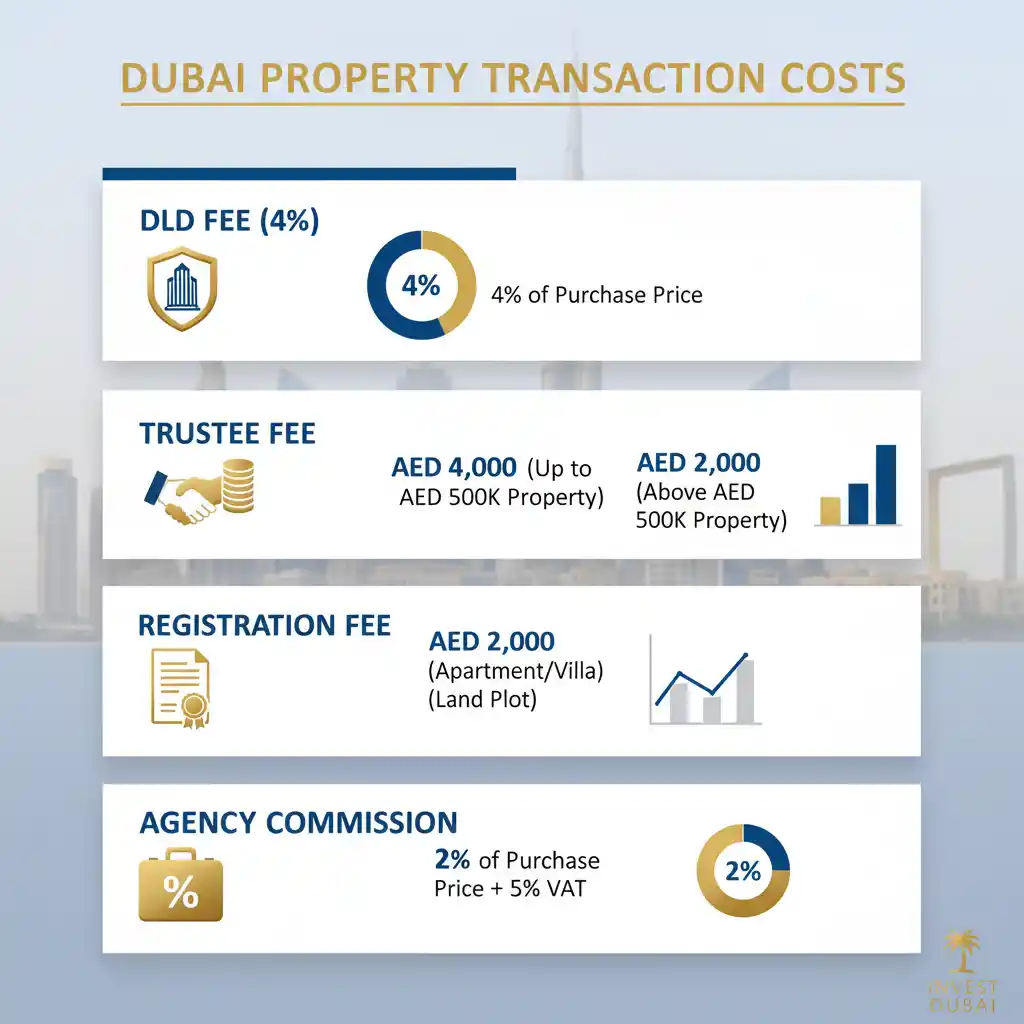
| Dubai Land Department (DLD) Transfer Fee | 4% of the purchase price |
| DLD Administration Fee | Additional administrative charges may apply depending on the transaction type |
| Trustee Office Fee | Typically around AED 4,000–AED 5,000 plus applicable VAT, depending on property value and transaction |
| Title Deed Issuance | Included within the registration process for many transactions, subject to DLD regulations |
For example, purchasing a property worth AED 2,000,000 means the DLD transfer fee alone is AED 80,000, making it the largest mandatory expense after the property’s purchase price.
Real Estate Agency Commission
If you purchase through a licensed real estate broker, you’ll usually pay an agency commission.
For most residential transactions, this commission is:
- Approximately 2% of the purchase price
- Plus 5% VAT on the commission amount
Although buyers sometimes negotiate this fee, 2% remains the standard market practice for secondary market transactions.
For off-plan properties sold directly by developers, buyers often do not pay a brokerage commission because the developer compensates the broker. However, this can vary depending on the project and sales arrangement.
Mortgage Costs
If you’re financing your purchase through a UAE bank, additional costs apply beyond your monthly mortgage repayments.
Common mortgage-related expenses include:
| Mortgage Expense | Typical Cost |
|---|---|
| Mortgage Registration Fee | 0.25% of the loan amount + AED 290 |
| Property Valuation | Approximately AED 2,500–AED 4,000 |
| Bank Processing Fee | Commonly up to 1% of the loan amount, depending on the lender |
These costs are generally paid before the mortgage is finalized and should be included in your upfront budget.
Hidden Costs Many Buyers Overlook
One of the biggest mistakes property investors make is budgeting only for the purchase price and mandatory government fees.
Several additional expenses can significantly increase your total investment, especially during the first year of ownership.
Service Charges
Every owner contributes to the maintenance of shared facilities within the community.
These annual charges typically cover:
- Security
- Cleaning
- Landscaping
- Swimming pools
- Gyms
- Building maintenance
- Common utilities
Service charges are usually calculated on a per-square-foot basis, meaning larger properties generally incur higher annual costs.
Premium waterfront developments and luxury communities often have noticeably higher service charges than suburban residential areas, which can influence your net rental yield.
Utility Connection Fees
After taking ownership, buyers are responsible for activating utilities.
Depending on the property and provider, initial connection costs may include:
- Electricity
- Water
- Cooling services (where applicable)
- Internet and telecommunications
Although these costs are relatively modest compared with the purchase price, they should still be considered when calculating your first-year ownership expenses.
Home Insurance
While not legally required for every buyer, property insurance is strongly recommended.
A comprehensive policy may cover:
- Fire damage
- Water leaks
- Natural events
- Accidental damage
- Landlord liability (for rental properties)
For investors planning to rent out their property, insurance provides additional financial protection against unexpected repair costs.
Key Takeaways So Far
Before making an offer on any property in Dubai, buyers should account for more than just the advertised price. Government transfer fees, registration charges, brokerage commissions, financing expenses, and ongoing ownership costs can substantially affect the total investment required. Building these costs into your financial plan from the outset leads to more accurate budgeting and better long-term investment decisions.
How Much Does It Really Cost to Buy Property in Dubai?
Understanding the official fees is only the first step. The real question every investor asks is:
“How much money do I actually need to complete the purchase?”
The answer depends on four factors:
- Purchase price
- Whether you’re buying with cash or a mortgage
- Property type (Apartment, Townhouse, or Villa)
- Whether the property is Ready or Off-Plan
For most ready properties, buyers should budget approximately 6%–8% above the purchase price to cover transaction costs. If financing is involved, mortgage-related expenses will increase the total slightly.
Buying a Ready Apartment for AED 1,500,000 (Cash Purchase)
The following example assumes a buyer purchases a completed apartment without financing and pays the standard brokerage commission.
| Cost Item | Calculation | Estimated Cost (AED) |
|---|---|---|
| Purchase Price | — | 1,500,000 |
| DLD Transfer Fee | 4% | 60,000 |
| Registration Trustee Fee | Fixed | 4,200 |
| Title Deed & Administrative Fees | Approximate | 600 |
| Agency Commission | 2% | 30,000 |
| VAT on Agency Commission | 5% | 1,500 |
| Total Upfront Costs | 96,300 |
Total Cash Required
| AED | |
|---|---|
| Property Price | 1,500,000 |
| Total Buying Costs | 96,300 |
| Total Investment Required | 1,596,300 |
In this scenario, the buyer needs approximately 6.42% above the property’s purchase price to complete the acquisition. Actual administrative charges may vary slightly depending on the transaction and trustee office.
Buying a Villa for AED 3,000,000 with a Mortgage
Now consider an investor financing 80% of the purchase price.
Loan Details
| Item | Value |
|---|---|
| Property Price | AED 3,000,000 |
| Down Payment (20%) | AED 600,000 |
| Mortgage Amount | AED 2,400,000 |
Buying Costs
| Cost Item | Calculation | Estimated Cost (AED) |
|---|---|---|
| DLD Transfer Fee | 4% | 120,000 |
| Trustee Registration Fee | Fixed | 4,200 |
| Title Deed & Admin Fees | Approximate | 600 |
| Agency Commission | 2% | 60,000 |
| VAT on Commission | 5% | 3,000 |
| Mortgage Registration Fee | 0.25% + AED 290 | 6,290 |
| Property Valuation | Typical bank fee | 3,000 |
| Bank Processing Fee | Up to 1% of loan (varies by lender) | Up to 24,000 |
Estimated Total Transaction Costs: AED 221,090
The exact bank processing fee depends on the lender and promotional offers. Some banks reduce or waive this fee during campaigns. Mortgage registration is officially charged at 0.25% of the mortgage amount plus AED 290.
Which Costs Are Negotiable?
Many buyers assume every fee is fixed. In reality, some costs are mandatory while others can be negotiated.
| Expense | Negotiable? |
|---|---|
| DLD Transfer Fee | No |
| Trustee Registration Fee | No |
| Mortgage Registration Fee | No |
| Title Deed Fees | No |
| Agency Commission | Yes |
| Bank Processing Fee | Sometimes |
| Property Price | Yes |
| Developer Incentives | Yes (Off-Plan) |
Negotiating even a 0.5% reduction in agency commission on a AED 2 million property can save approximately AED 10,000, while developer incentives on off-plan projects may include waived registration fees or payment of part of the DLD fee during promotional periods.
Apartment vs Townhouse vs Villa: Which Costs More?
The purchase process is largely the same across residential property types, but the ongoing cost of ownership can differ significantly.
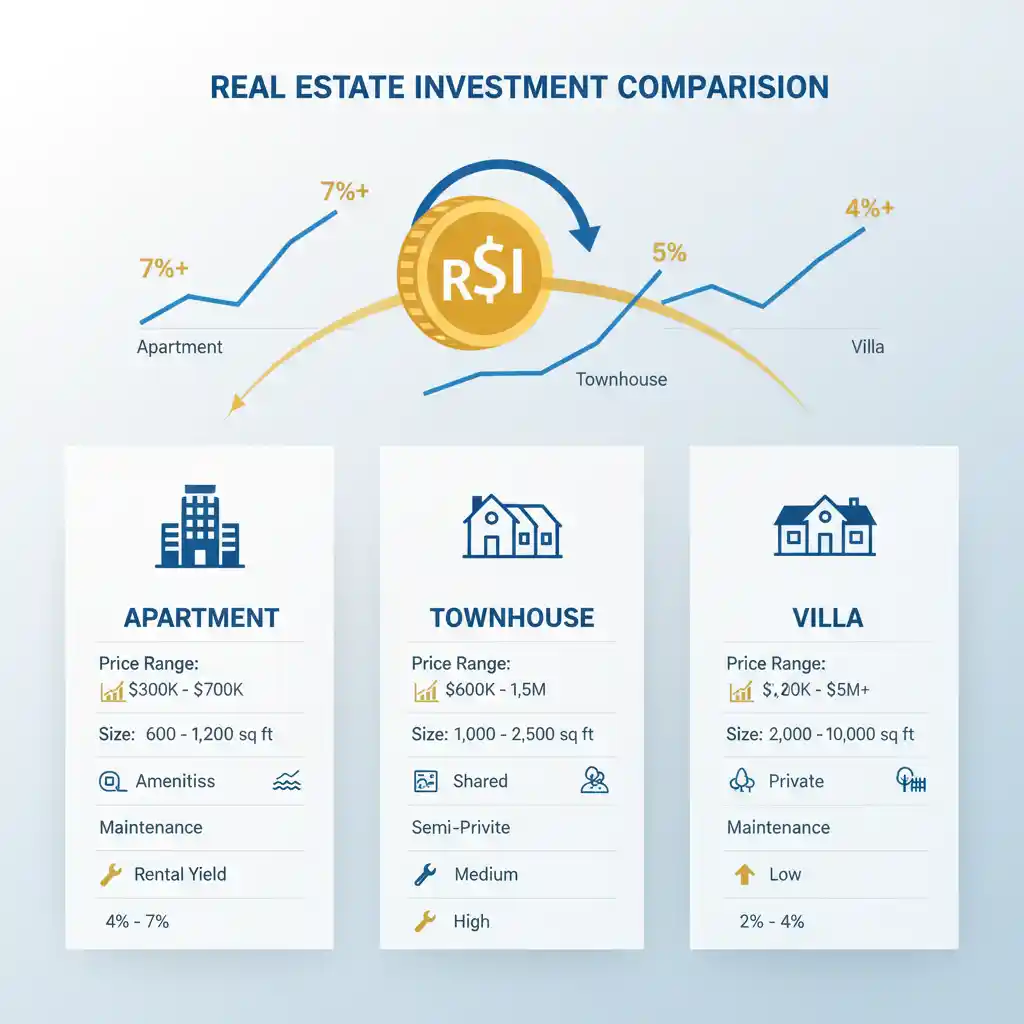
| Factor | Apartment | Townhouse | Villa |
|---|---|---|---|
| Purchase Price | Lower | Medium | Higher |
| DLD Fee | 4% | 4% | 4% |
| Trustee Fee | Same | Same | Same |
| Service Charges | Higher per sq. ft. | Moderate | Usually lower per sq. ft., but larger area means higher total bill |
| Maintenance Responsibility | Low | Medium | High |
| Rental Yield Potential | Generally higher in prime urban areas | Balanced | Often lower yield but stronger lifestyle appeal |
| Capital Appreciation | Strong in high-demand districts | Strong | Strong in limited-supply villa communities |
While villas often have lower service charges per square foot than apartments, their larger built-up areas and plot sizes usually result in higher overall maintenance and operating costs.
Annual Ownership Costs After Buying
Many first-time investors focus only on acquisition costs and overlook recurring annual expenses.
These ongoing costs directly affect net rental yield, making them essential for investment planning.
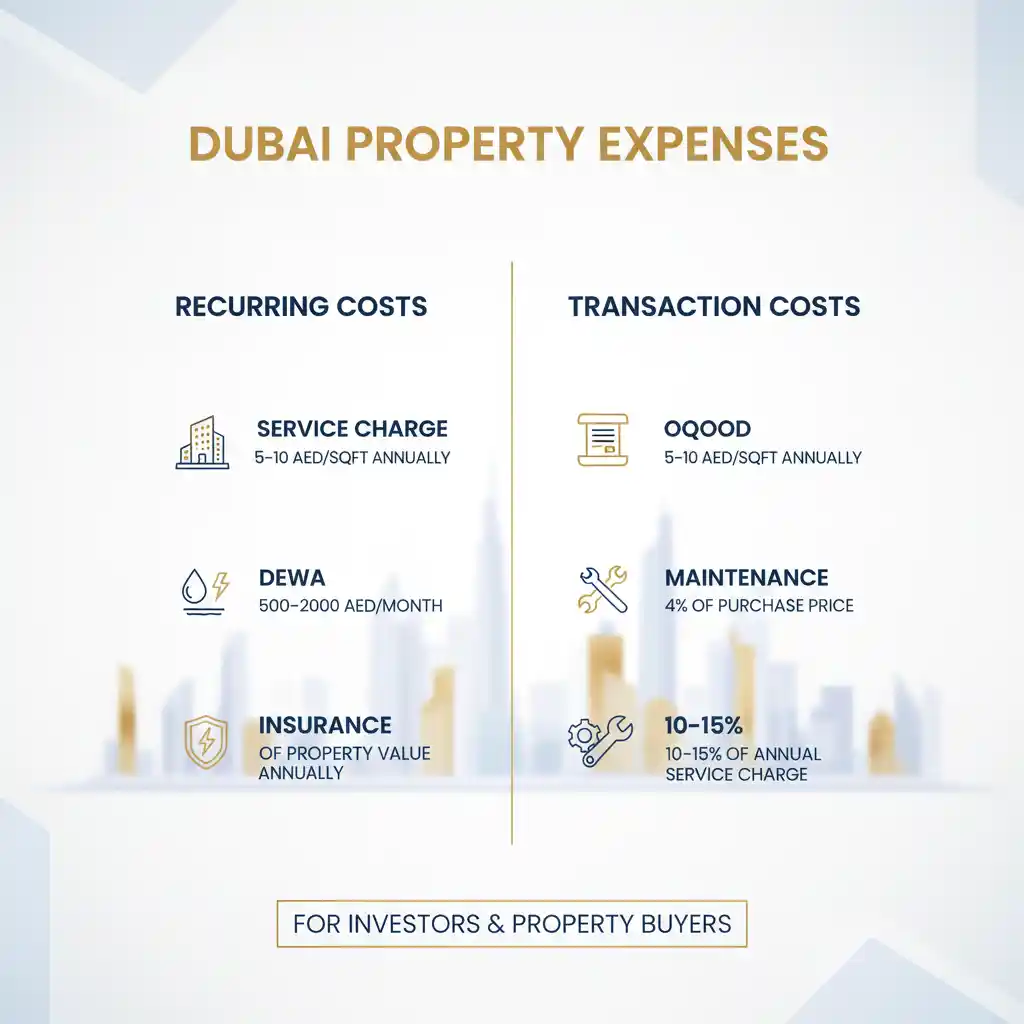
| Annual Expense | Typical Range |
|---|---|
| Service Charges | Varies by community and property type |
| Property Management | Around 5%–8% of annual rental income (if outsourced) |
| Home Insurance | Depends on property value and coverage |
| Maintenance Reserve | Recommended for villas and older properties |
| Utilities (if owner-occupied) | Based on consumption |
For buy-to-let investors, accurately forecasting these annual costs is just as important as calculating the initial purchase expenses, as they have a direct impact on cash flow and long-term returns.
Why This Matters for Investors
Two properties with the same purchase price can generate very different investment outcomes if one has substantially higher annual service charges or maintenance requirements.
Before committing to any purchase, calculate:
- Total acquisition costs
- Expected annual ownership costs
- Estimated rental income
- Net rental yield after expenses
Evaluating these four elements together provides a much clearer picture of the property’s true investment potential than looking at the purchase price alone.
Off-Plan vs Ready Property: Which Costs More?
One of the biggest misconceptions among buyers is that off-plan properties are always cheaper to purchase than ready homes. If you’re still comparing both options, our guide on Off-Plan vs Ready Units in Dubai explains the differences in pricing, payment plans, rental income potential, and long-term investment returns before you decide.
While off-plan developments often require a lower initial payment, the total cost of acquisition depends on developer incentives, registration fees, financing options, and long-term ownership expenses—not just the advertised purchase price.
The table below compares the main cost differences.
| Cost Category | Ready Property | Off-Plan Property |
|---|---|---|
| Purchase Price | Paid to the seller | Paid according to the developer’s payment plan |
| DLD Fee | Usually 4% of the purchase price | Usually 4% (some developers cover part or all of this during promotions) |
| Trustee Office Fee | Applicable at transfer | Generally not applicable in the same way as secondary-market transfers |
| Oqood Registration | Not required | Required for off-plan registration |
| Agency Commission | Typically around 2% in secondary sales | Often paid by the developer, though this depends on the project |
| Mortgage Availability | Available immediately (subject to lender approval) | Usually available only after construction reaches lender-required milestones |
| Rental Income | Immediate | Starts after project handover |
| Capital Appreciation Potential | Moderate | Potentially higher, with higher market risk |
Investor Insight:
Off-plan properties can reduce initial cash outlay because developers may offer incentives such as waived DLD fees, post-handover payment plans, or commission-free sales. However, buyers should compare the total acquisition cost and expected return rather than focusing solely on the down payment.
Hidden Costs That Can Increase Your Investment Budget
The purchase price and government fees are only part of the equation. Many investors underestimate several additional expenses that arise before or shortly after taking ownership.
Understanding these costs in advance helps prevent budget overruns and provides a more accurate picture of your total investment.
Oqood Registration (Off-Plan Properties)
If you purchase an off-plan property, the transaction is registered through the Oqood system managed by the Dubai Land Department.
The applicable fee depends on the project’s registration requirements and current DLD regulations. Buyers should confirm the exact amount with the developer before signing the Sales Purchase Agreement (SPA).
Unlike a Title Deed, Oqood serves as proof of ownership during the construction phase until the project is completed and the final title can be issued.
No Objection Certificate (NOC)
For many secondary market transactions, the developer must issue a No Objection Certificate (NOC) before ownership can be transferred.
The NOC confirms that there are no outstanding service charges or obligations associated with the property.
The fee is developer-specific and commonly ranges between AED 500 and AED 5,000, depending on the developer and the project.
In many transactions, the buyer and seller negotiate who will bear this cost.
DEWA Connection Charges
After taking possession of a ready property, buyers generally need to activate their electricity and water account with the Dubai Electricity and Water Authority (DEWA).
The required security deposit is currently:
| Property Type | Security Deposit |
|---|---|
| Apartment | AED 2,000 |
| Villa | AED 4,000 |
This deposit is refundable when the DEWA account is closed, provided there are no outstanding balances. It should therefore be viewed as a temporary cash requirement rather than a permanent cost.
District Cooling Deposits
Many residential communities in Dubai use district cooling providers instead of individual air-conditioning systems.
Depending on the provider, buyers may be required to pay:
- A refundable security deposit
- Account activation fees
- Initial connection charges
These amounts vary by community and service provider and should be confirmed before completion.
Property Insurance
Although property insurance is not mandatory for every cash buyer, it is often required by mortgage lenders.
Annual premiums vary according to:
- Property value
- Type of coverage
- Building age
- Contents insured
Insurance is a relatively small expense compared to the overall investment but can protect against substantial financial losses.
Property Management Fees
Investors living outside the UAE frequently appoint a professional property management company to oversee their rental property.
Typical services include:
- Tenant sourcing
- Rent collection
- Maintenance coordination
- Inspection reports
- Contract renewals
Management fees generally range from 5% to 8% of the annual rental income, depending on the scope of services and the management company.
Budget Planning Based on Your Investment Goal
Different investors have different priorities. A buyer focused on rental income may choose a different strategy than someone seeking long-term capital appreciation or a family home.
The table below provides a practical framework for aligning your budget with your objectives.
| Budget | Typical Property Type | Primary Goal | Key Consideration |
|---|---|---|---|
| Up to AED 1 million | Studio / 1-Bed Apartment | Rental income | Lower entry cost, higher tenant demand in many established communities |
| AED 1–2 million | Apartment or Townhouse | Balanced growth and yield | Compare service charges and expected rental returns |
| AED 2–4 million | Larger Apartment, Townhouse, or Villa | Capital appreciation | Assess community infrastructure and future supply |
| Above AED 4 million | Luxury Villa or Premium Residence | Wealth preservation and long-term growth | Focus on limited-supply locations and ongoing ownership costs |
Decision Guide Based on ROI
Choosing the right property is not just about affordability—it is about matching the asset to your investment strategy.
| Your Goal | Recommended Property | Why |
|---|---|---|
| Maximise Rental Yield | Apartment | Lower entry price and historically strong rental demand in many urban districts |
| Long-Term Capital Growth | Off-Plan Apartment or Townhouse | Potential appreciation during construction, with higher project risk |
| Family Living | Villa | More space, privacy and lifestyle amenities |
| Passive Income | Ready Apartment | Immediate rental potential after purchase |
| Lower Initial Cash Outlay | Off-Plan Property | Flexible payment plans offered by many developers |
Common Budgeting Mistakes Buyers Make
Even experienced investors can underestimate the true cost of buying property.
Some of the most common mistakes include:
- Calculating only the purchase price and ignoring transaction costs.
- Forgetting annual service charges when estimating rental yield.
- Assuming all developers offer the same incentives.
- Not budgeting for utility deposits and activation fees.
- Overlooking mortgage-related charges beyond the down payment.
- Failing to compare the total cost of ownership across different property types.
Avoiding these mistakes can significantly improve both financial planning and long-term investment performance.
Frequently Asked Questions
1. How much are the total buying costs in Dubai?
Most buyers should budget 6% to 8% above the property’s purchase price. This typically includes the 4% DLD transfer fee, registration costs, trustee office fees, agency commission, and mortgage-related charges (if applicable).
2. Is there property tax in Dubai?
No. Dubai does not charge annual property tax or capital gains tax on residential real estate. However, owners are responsible for annual service charges and maintenance costs.
3. Who pays the Dubai Land Department (DLD) fee?
The standard 4% DLD transfer fee is usually paid by the buyer, although in some off-plan projects developers may offer to cover part or all of this fee as a promotional incentive.
4. Are off-plan properties cheaper to buy?
Off-plan properties often require a lower initial payment and may include developer incentives. However, buyers should compare the total cost of ownership, payment schedule, and expected return rather than focusing only on the purchase price.
5. What ongoing costs should property owners expect?
Annual expenses typically include service charges, maintenance, insurance (optional or lender-required), utilities, and property management fees if the property is rented out through a management company.
6. Can foreigners buy freehold property in Dubai?
Yes. Non-UAE nationals can purchase freehold property in designated areas approved by the Dubai government.

Understanding Dubai Property Buying Costs is essential before making any real estate investment. Looking beyond the purchase price—and accounting for government fees, financing costs, and ongoing ownership expenses—allows buyers to budget accurately and make informed decisions. Whether you’re purchasing a ready home or an off-plan property, calculating the full cost of ownership is the key to maximizing your investment and avoiding unexpected expenses.
Planning to invest in Dubai real estate? Our team at Town Crown can help you estimate your total buying costs, compare ready and off-plan opportunities, and choose a property that matches your budget and investment goals. Contact us today for a personalized consultation.